SAN RAFAEL ENERGY
Renewable Solar and Battery Project
Project Summary
The San Rafael Energy Project is being developed by Torch Clean Energy, a longstanding developer and owner of renewable energy assets with a focus in the desert southwest.
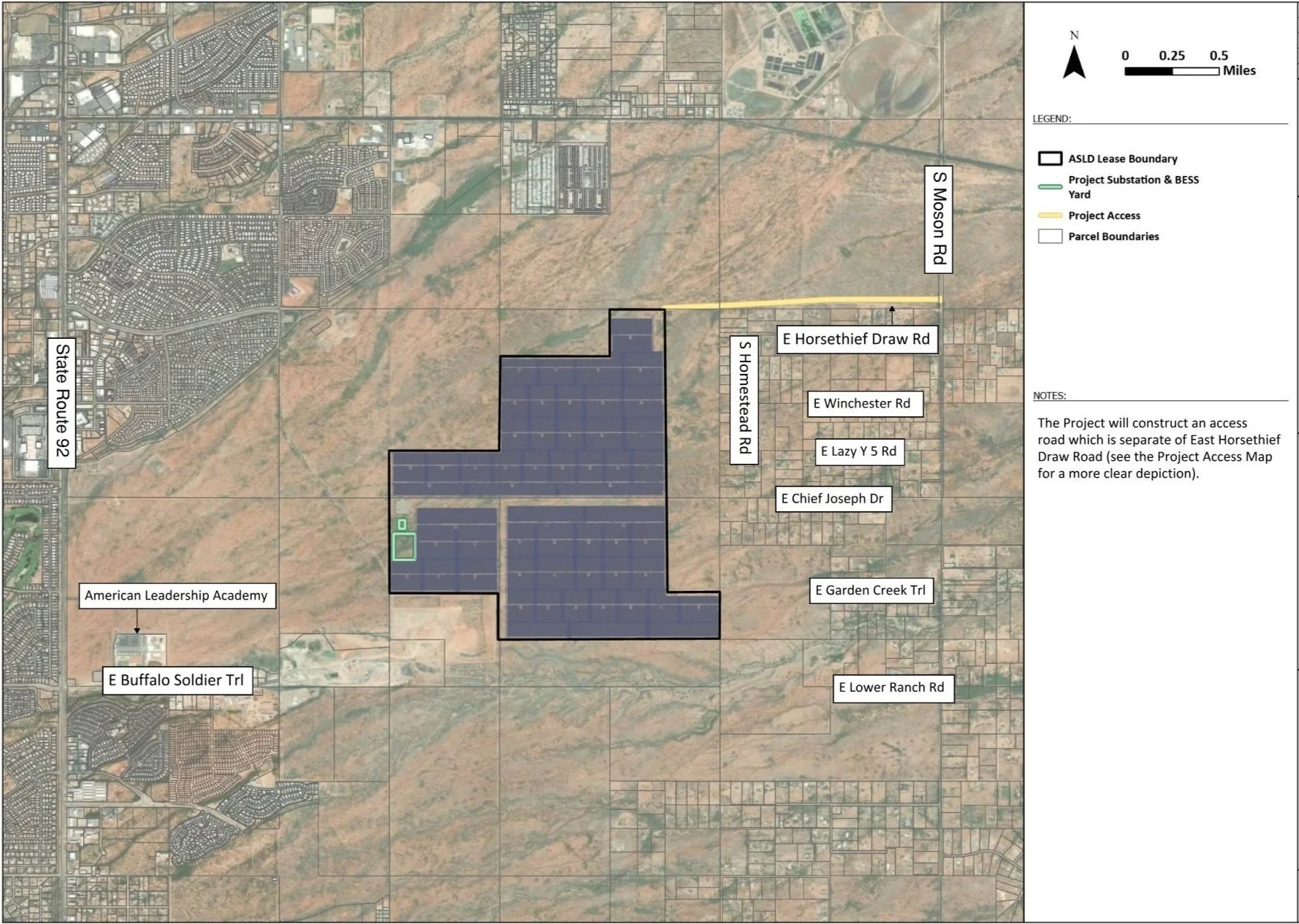
The Project is located within the City of Sierra Vista in Cochise County on approximately 1060 acres of State Trust land. (See map with concept plan below or PDF here).
Community Open House
At the community meeting held on 8/19/26, the Project Team met with the community to discuss information about the project and hear citizen comments.
Visual Simulations
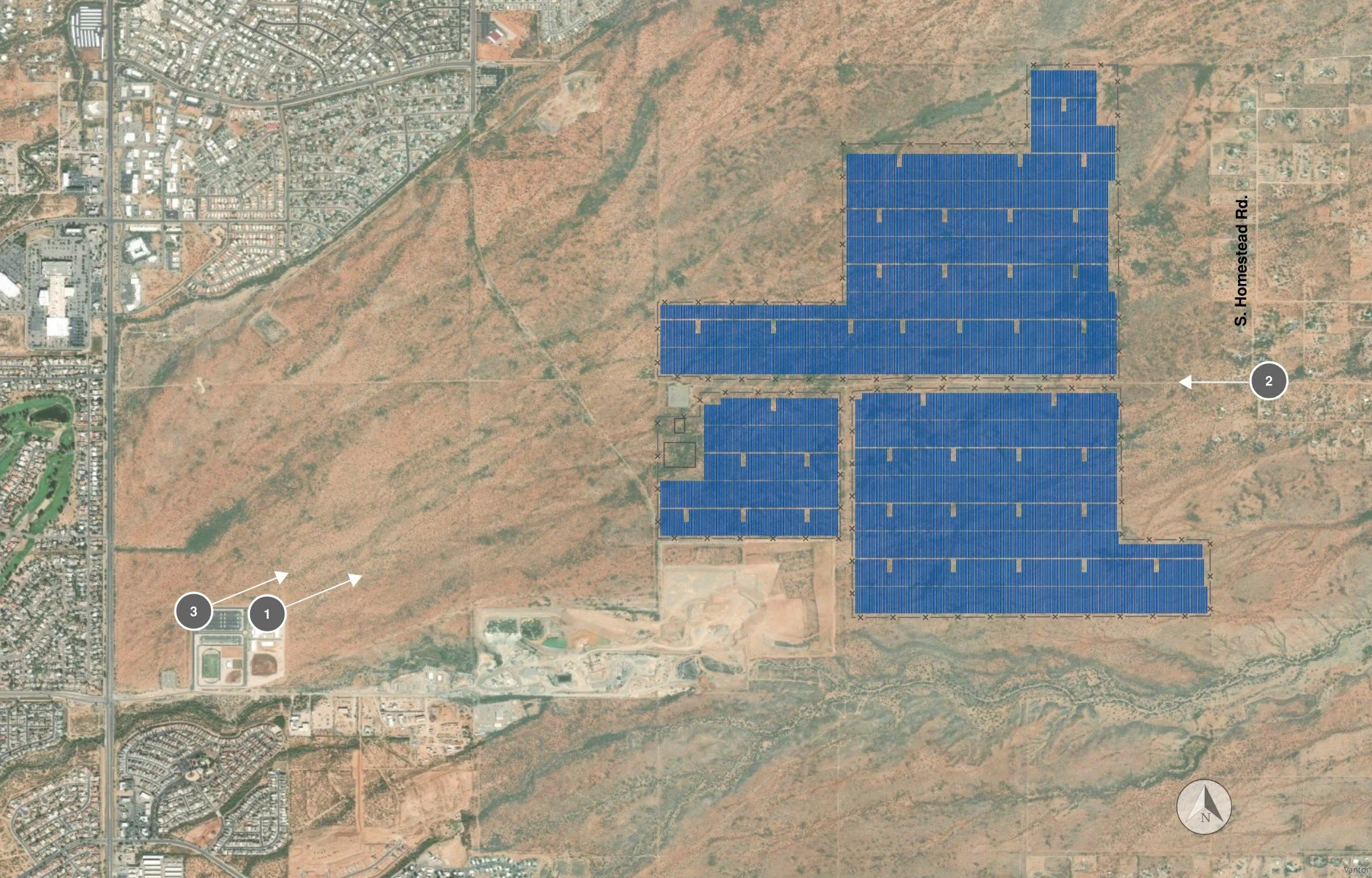
Visual simulations blend together 3-D models of the project and 3-D topography of the area, to match with the metadata from photos to create a simulated view of the project.
Project DOcuments
The Biological Evaluation for the San Rafael Energy Park project was prepared to provide environmental permitting support that pertains to the ESA and relevant state and local biological regulations.
Q&A
-
Solar and storage projects like San Rafael Energy Park (the “Project”) need a combination of open, relatively flat land and proximity to existing transmission infrastructure that can support new generation. This Project is located next to the Arizona G&T Cooperatives’ (“AEPCO”) San Rafael Substation, eliminating the need for a lengthy transmission line connecting the Project to the grid. This substation also has availability to take new energy generating resources without requiring system upgrades, making it a cost-effective way to bring new generation to the community.
-
The Project will interconnect to Arizona G&T Cooperatives' transmission system, delivering electricity to the regional grid where it will become part of the overall power supply serving local homes and businesses.
-
Due to the Project’s location within the city’s Urban Ranch zoning district, the Project is not subject to a Special Use Permit or other discretionary entitlement process. Regardless, in order to memorialize site development standards and demonstrate the Project’s commitment to transparency, the Project executed a Memorandum of Understanding with the City of Sierra Vista in April 2026. The site development standards largely reflect those which were incorporated into the neighboring Winchester Solar I and II projects’ Special Use Permit; these solar and battery projects are currently under construction and on track to be operational in 2027.
The San Rafael Project is expected to begin construction 2027 and begin operations in 2029. As the Project progresses through the development and design phases, the team is eager to incorporate community input and work hand in hand to resolve any outstanding questions.The San Rafael Project is expected to begin construction mid-2027 and begin operations in early 2029. As the Project progresses through the development and design phases, the team is eager to incorporate community input and work hand in hand to resolve any outstanding questions.
-
Utility-scale battery energy storage systems ("BESS") carry a statistically low fire risk. These systems have a strong safety record that keeps improving as the technology matures. Since 2021, the industry has shifted toward lithium iron phosphate ("LFP") chemistry, which has an ignition point 200 degrees higher than the previously used nickel manganese cobalt ("NMC") batteries. Since 2021, 50,000 MW of batteries have installed, and in this period there have been only four recorded fire incidents involving LFP BESS and no incidents in the last two years. The industry-wide shift to LFP, along with stronger enclosure design and containment standards, has been a major factor behind the continued decline in failure rates despite a large increase in the number of installed systems.
Battery enclosures are built to keep any failure contained. Barriers separate individual cells and modules, and enclosures are spaced apart so a rare thermal event would stay confined to a single unit rather than spreading across the site.
Safety codes have also continued to develop and set more rigorous requirements for containment and testing. Most past incidents have traced back to installation or assembly issues rather than the battery chemistry itself, which is why quality design, commissioning, and code compliance are the real safeguards.
A BESS fire does produce fumes, similar to an ordinary structure fire, but they disperse quickly outdoors and, given the BESS yard's distance from homes, would not be measurable in the surrounding community. Real-world BESS fires monitored across the country have consistently shown no health risk to nearby residents, even in cases where the fire burned for an extended period.
Sources: American Clean Power Association and Fire & Risk Alliance, LLC, Assessment of Potential Impacts of Fires at BESS Facilities (September 2025); American Clean Power Association, Claims vs. Facts: Energy Storage Leading on Safety (December 2023); Electric Power Research Institute, TWAICE, and Pacific Northwest National Laboratory, Insights from EPRI's Battery Energy Storage Systems (BESS) Failure Incident Database: Analysis of Failure Root Cause (May 2024); EPRI, The Evolution of Battery Energy Storage Safety Codes and Standards (2023); EPRI BESS Failure Incident Database.
-
The Project Team is working directly with the City's Fire Marshal to develop the Emergency Response Plan so there are systems in place in the unlikely event of an incident. Further coordination and training with local fire and emergency responders will occur as the Project advances.
-
Research from multiple academic institutions has found no material negative property value impact from neighboring utility-scale energy projects, especially in more rural locations where land is far more abundant and scarcity isn't a factor.
Other research has found that solar can have a neutral or even positive effect on nearby home values. Property value experts generally agree that the factors most likely to decrease home values – increased noise, odor, and traffic – don't apply to solar and storage facilities. These are quiet sites that don't emit odor or pollution, and once construction is complete, they have minimal impact on local traffic.
In fact, as projects like these contribute substantially to their communities’ tax base, property values may be bolstered by quality schools, roads, and local services.
Though visual impact can influence neighboring perceptions, the Project will be naturally screened by mesquite vegetation. Visual simulations are available to demonstrate how the Project remains out of sight, maintaining the community’s sightlines of the natural landscape.
Sources: Al-Hamoodah, Leila; Koppa, Kavita; Schieve, Eugenie; Reeves, D. Cale; Hoen, Ben; Seel, Joachim; and Rai, Varun. 2018. An Exploration of Property-Value Impacts Near Utility-Scale Solar Installations. Policy Research Project (PRP), LBJ School of Public Affairs, The University of Texas at Austin, May 2018.
-
No, the operation of a solar and BESS project facility requires very little water. Most of the water associated with the project is used during construction for dust control during grading and site preparation. Once construction is complete, the only ongoing need for water is occasional panel cleaning to remove dust in order to maintain output, which may not be necessary given the region’s annual monsoonal rains. Utility-scale projects also use tracking systems that tilt panels through a range of angles throughout the day, which benefit from wind and gravity shedding accumulated dust between cleanings. Panel washing is only scheduled when monitoring data shows that soiling is notably reducing energy production, not on a routine basis.
-
By design, solar panels are designed to minimize glare rather than create it since any reflected light is wasted potential energy. Because of this, panels are made of dark, anti-reflective materials and typically reflect as little as 2% of incoming sunlight, which means they’re less reflective than soil or wood shingles. Utility-scale solar has been installed at dozens of U.S. airports without incident, and the FAA continues to allow it at many airports today. To substantiate these claims, a Glint and Glare study is currently underway and will be shared with Fort Huachuca and the City of Sierra Vista.
-
Once construction is complete, solar and BESS facilities are very quiet neighbors. The main ongoing sound from a solar project comes from the inverters, which convert the panels' DC electricity into grid-usable AC power, and their cooling fans. Inverter noise measures around 58 decibels (comparable to conversational noise or a running refrigerator) and becomes inaudible at a distance of about 150 feet. No sound is emitted from the solar site at night when there’s no power generation. During construction, there will be a few months of pile driving during which measured noise levels run ~60 dBA from 800 feet away. Since residences are over 1,000 ft from pile installations, neighbors should experience minimal disturbance.
-
Since tall vegetation can shade panels and reduce output, vegetation management is an important part of operating a solar facility. Vegetation management generally includes a combination of seeding and mowing in order to maintain site stabilization while keeping panels free from shading. During and following construction, native plant mixes will be seeded to restore vegetation on-site and reduce the chances for noxious and invasive plants from establishing a presence.
-
The global supply chain for solar and battery components draws equipment from many different countries, but federal incentives for domestic content lead projects like this one to prioritize as much American-made equipment as possible. The Project is also in coordination with Fort Huachuca to ensure the equipment installed meets and exceeds any grid safety and security requirements.The global supply chain for solar and battery components draws equipment from many different countries, but federal incentives for domestic content lead projects like this one to prioritize as much American-made equipment as possible. The Project is also in coordination with Fort Huachuca to ensure the equipment installed meets and exceeds any grid safety and security requirements.
-
Decommissioning will not cost anything to the public or landowners. The Project will include a decommissioning plan as well as financial security posted with the city or state land department to ensure sufficient funds are available to remove all site components once the facility is retired. The Project is responsible for ensuring all pertinent installed facilities are removed per that plan.
-
The project team will submit both Traffic and Construction Management Plans to the City as well as a Dust Control Plan as part of the Project's site plan submittal package. During construction, the site will be monitored daily and will deploy water trucks as needed to contain fugitive dust. Construction traffic will be most concentrated in the early months of the construction process with site prep and equipment deliveries. Workers will be instructed to use main arterial roads wherever possible to limit disturbance on quieter streets.
-
The project was intentionally sited to keep significant distance from neighboring homes, with the nearest residences approximately one-quarter mile from the Project's eastern perimeter. The dense mesquite that naturally surrounds the Project area will provide both a physical and visual buffer between the Project and nearby residences as shown in the visual simulations here [hyperlink on website]. Visual simulations were prepared from observation points at the American Leadership Academy and along E Chief Joseph, east of the Project.
-
The Project team is working with civil engineers who have completed hydrological modeling of the Project site and reviewed the City's stormwater ordinance. Based on that modeling and the City's code requirements, stormwater detention basins are being designed within the Project area where necessary to manage runoff. The stormwater basins are designed so that runoff leaving the site does not exceed pre-construction levels.
-
Research on utility-scale solar facilities has found that temperatures remain at ambient levels within a short distance of the project boundary. With the nearest residences approximately one-quarter mile away and dense mesquite between the Project and nearby homes, the Project is not expected to increase temperatures in surrounding neighborhoods.
Sources: Fthenakis, Vasilis; and Yu, Yuanhao. 2013. Analysis of the Potential for a Heat Island Effect in Large Solar Farms. 2013 IEEE 39th Photovoltaic Specialists Conference (PVSC), Tampa, FL, pp. 3362–3366. doi:10.1109/PVSC.2013.6745171.
-
The Project will generate clean, renewable electricity without producing air emissions or using water for power generation. It will also provide new property tax revenue that supports local schools and public services while placing minimal demand on City infrastructure. During construction, the Project will create temporary jobs and bring increased spending to local businesses.
-
No, the Project is not associated with a data center or any other development within the City and will only be submitting a Site Plan application for a utility-scale solar and BESS facility.